Most bilingual wedding invitations fail for one of two reasons, and translation is neither. Either the card was set in English with the second language poured into the space left over, or nobody chose which family led and the printer chose for them. A language set 9-point in grey under 12-point black has been ranked, wherever it sits.
The first is a typesetting problem and takes an afternoon. The second is a family problem and outlasts the wedding. What follows is what stationers get asked once the proof comes back: which language leads, how two fit on one card, which scripts refuse a Latin grid, and the words machine translation always gets wrong.
When are bilingual wedding invitations the wrong tool?
Count the guests who cannot comfortably read the main language. If that comes to one in twenty or fewer, a bilingual card is overkill. Set the invitation in English, set it again in the other language, and post the second version to the 14 people who need it. Nobody should read their own invitation in 8-point type because the other language took the top half.
The reason to do it anyway is standing rather than comprehension. A card carrying both languages says the two families are equal parties. A translation handed discreetly to one side says something else, and everyone present understands which.
One question decides it. If the second language vanished from the card tomorrow, would anyone be offended, or merely inconvenienced? Offence means bilingual. Inconvenience means two versions.
There is a middle case worth naming. Where one family reads the main language perfectly well but treats the other as a matter of identity, the card is not doing translation work at all. It is doing recognition work, and in that situation the wording can be shorter in the second language without anybody minding, provided it is set at the same size.
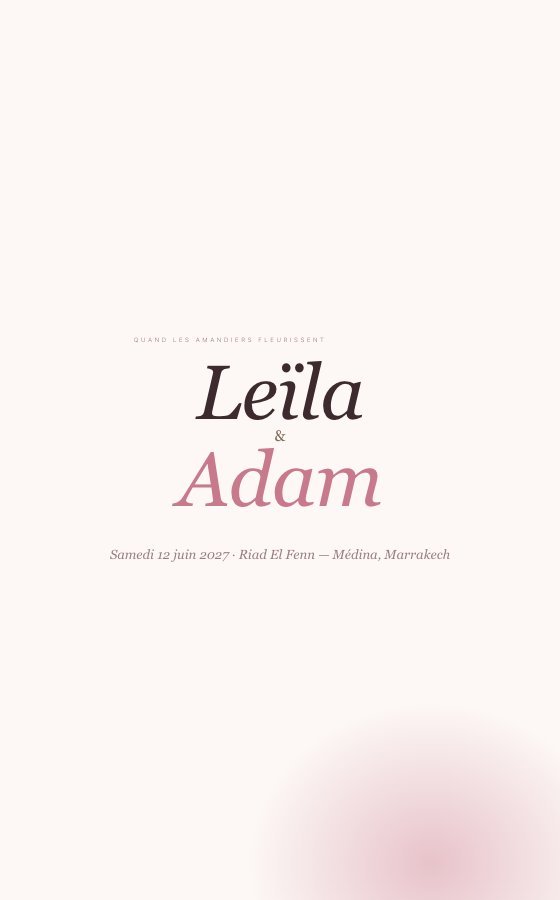
A TislitEvent invitation is served in seven languages from one link, so neither family has to be the one printed second.
Which language goes first, and what that tells both families
Whatever sits at the top, on the left, or on the front is the primary language. Readers assign rank to position, and they are right to, because the hierarchy is real and the designer put it there.
Use an external rule and name it out loud
Three rules survive a family dinner. First comes the language of the country the wedding is held in. Then the language of the ceremony. Then the language more guests read. Each one is a fact rather than a preference, which is exactly why it settles the argument.
« The ceremony is in Spanish, so the card leads in Spanish » closes a conversation. « It looked better that way » opens one. Size and colour are not neutral either, so keep both languages at the same point size and the same ink weight unless you mean the ranking.
The honest fix costs a second print run
Print two versions. Each family’s language leads on the cards going to that family, and both languages appear on both. It costs a second set-up and a second proof, and it is invisible to everyone except the two cousins who compare cards at the reception. They will compare, so say plainly that each side has its own.
Side by side, back to back, or two separate cards
| Format | Where it goes wrong | Cost and postage |
|---|---|---|
| Side by side, two columns on one face. | Columns drift out of step once one language runs longer. | One card, one run, a Letter at 91p second class. |
| Back to back, one language per face. | The front is the primary language, and it opens backwards for an Arabic reader. | Same card, same postage band. |
| Two cards in one envelope. | Nobody reads both, and the envelope crosses into Large Letter. | Two runs, £1.55 second class, so £155 per hundred. |
| Two mailings, split by guest language. | Two set-ups, two proofs, two chances of an error. | Two short runs cost more per unit than one long one. |
| One digital invitation, one link per guest language. | Nothing for the mantelpiece. | Flat price, no printing, no postage. |
Postage decides this more often than taste does. One card and an envelope stay inside Royal Mail’s Letter format, capped at 240mm by 165mm by 5mm and 100g, at 91p second class on the rates effective 5 October 2026.
Add a second card and an RSVP card and the pack becomes a Large Letter at £1.55, so £155 per hundred. Stamped reply envelopes add another £91. That sits against an average UK stationery spend of £378, according to Bridebook’s UK Wedding Report, which means postage alone can eat two thirds of the budget.
The script decides the layout, not the other way round
A typeface is not a language setting. Most of the trouble on bilingual wedding invitations comes from typing the second language into the font chosen for the first.
Right to left mirrors the furniture, not just the words
Arabic, Hebrew and Urdu reverse the whole composition. A monogram in the top left is now in the wrong corner, and a gate-fold opens backwards. Numerals still run left to right inside a right-to-left line, so the date and the time sit in a pocket of opposite direction. That is the commonest place a card renders wrongly.
Arabic joins, so it cannot be letterspaced. The tracking applied to English small caps breaks the words into isolated letters. It has no capitals either, so hierarchy has to come from size and weight. Urdu set in Nastaliq slopes downwards across each line and wants far more leading than the Latin beside it.
Devanagari and Chinese need their own faces
Hindi, Marathi and Nepali hang from the shirorekha, the line along the top of the word. Conjuncts stack downwards and diacritics upwards, so the line runs deeper than Latin and English leading clips the marks off. No English wedding script contains Devanagari, so a second face is compulsory. Match stroke contrast first, weight second, mood third.
Chinese characters fill a full em, so at the same point size Chinese reads bigger. Set it slightly smaller, by eye. There is no italic, and the punctuation is full width.
Greek, Cyrillic and the accent your script font lacks
Plenty of Latin families claim Greek and Cyrillic, and fewer draw them well. The tell in Cyrillic is the italic, which uses different letterforms rather than slanted romans, and a native reader spots the fake instantly. Most calligraphic faces cover Western European accents and stop there, so Polish and Vietnamese diacritics fall back to a substitute. One letter of the bride’s father’s name then arrives in Arial.
Line length, and the centred layout that stops working
English is short. German compounds are not, as reception against Hochzeitsempfang demonstrates. Spanish and Portuguese run long too, while Chinese turns an English line into six characters. Centred type is where this shows, because two columns of unequal depth never finish level, and by line 4 the block looks broken.
- Break the card into blocks, so names, date, venue, time and reply each centre separately and absorb their own overrun.
- Set both languages left-aligned in two columns with a gutter. Less romantic, far more robust, and what every working bilingual document does.
- Anchor both columns at the top and rule under the shallower one, so the uneven bottom edge reads as deliberate.
Do not shrink the longer language to fit. That is the ranking problem coming back through the door, and on bilingual wedding invitations it gets noticed within a week.
Names, honorifics and dates that do not survive translation
- Absorbed names. « Mr and Mrs John Whitfield request the pleasure of your company » removes the wife’s name entirely. Spanish has no equivalent, since a woman keeps both her surnames.
- Family name first. Chinese, Korean, Japanese and Hungarian names lead with the family name. Wang Wei is Mr Wang, so a card to Mr Wei has it backwards.
- Suffixed honorifics. Hindi and Gujarati honour with -ji after the name, so an English title in front doubles up.
- Never transliterate unasked. In many Arabic names the element resembling a surname is not one, and Mohamed, Muhammad and Mohammed are not interchangeable to their owner.
Dates are written differently, and not only in words
06/07/2027 is the sixth of July in Britain and the seventh of June in the United States, so numerical dates have no place on a card. Write it out in full in both languages, with the weekday. Chinese runs year, month, day.
French, German and Spanish guests expect a 24-hour clock, so 2pm becomes 14h00. Decide early about second calendars as well. The Hebrew date turns over at sunset, so a Saturday evening wedding falls on the following Hebrew day.
Which translation errors come back every time?
- Reception. Spanish recepción and German Rezeption are hotel front desks. What is wanted is banquete or Hochzeitsfeier, with vin d’honneur for the drinks and dîner for the meal.
- Religious formulae. These are quotations, not sentences. The Ganesh invocation at the head of a Hindu card and the bismillah on a Muslim one each have a received wording. Take the line from the priest, imam or pandit and set it exactly.
- Mr and Mrs. Translate the intention, which is formality, rather than the two words.
- Wedding breakfast. This is the British name for the seated meal after the ceremony, whatever the hour. Translated literally it becomes breakfast, and guests eat before they come.
- RSVP and plus one. RSVP is an instruction to English, French and Spanish speakers and four Latin letters to everybody else. Write it out with the date instead.
Proofing bilingual wedding invitations before print
One rule covers most of it: two native readers per language, one of them over sixty. Invitation register is not conversational language, and a fluent twenty-five-year-old waves through wording an older relative reads as curt. Check the printer’s proof too, because an unembedded font disconnects Arabic and collapses Devanagari.
Where bilingual wedding invitations stop being necessary
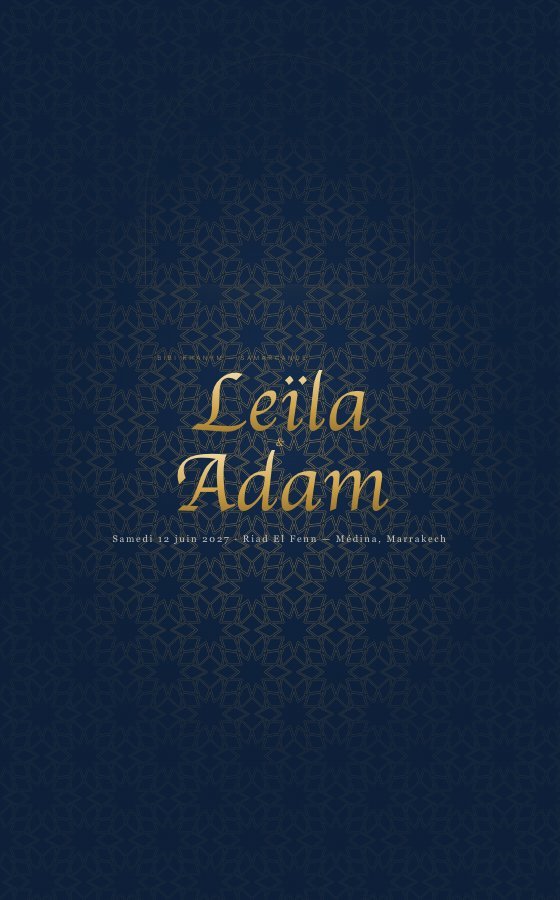
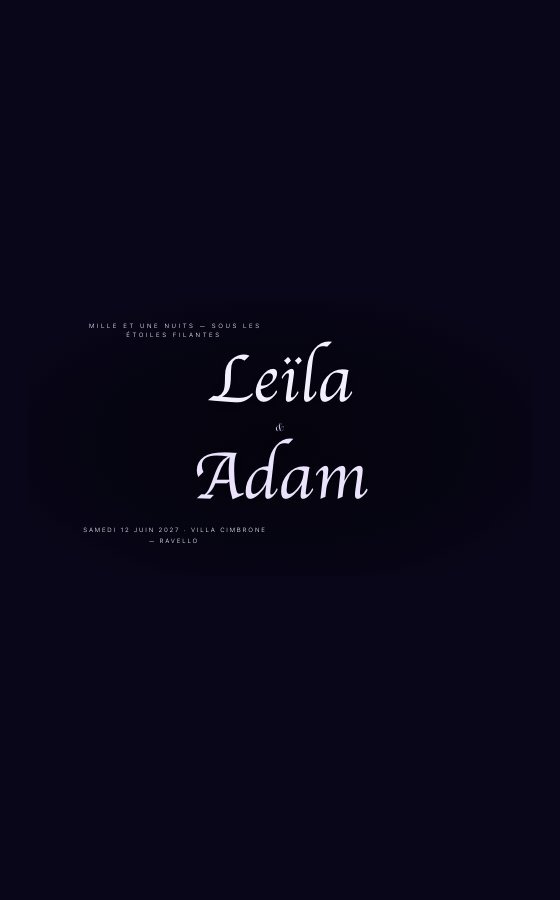
All of this exists because a printed card can only be in one state at a time. It has a front and a back, and somebody has to be second. Digitally the constraint disappears, since each guest opens the invitation in their own language, in a face chosen for that script. TislitEvent serves one link in 7 languages at a flat price, whatever the guest count.
Three scripts and five events
Indian weddings are where this stops being a typographic nicety. Mehndi, sangeet, haldi, ceremony and reception spread over 3 to 5 days, often with a different guest list for each. The card carries a Ganesh invocation at the head, with Hindi, Gujarati, Punjabi or Tamil beside the English.
The reply question is not whether a guest will come but which of the five events. The dietary question is not vegetarian or otherwise but vegetarian, Jain, halal, and who fasts on which day. Printing that per guest, in two scripts, across five events, is logistics before it is design. Print a short run for the elders who expect a card, and send everyone else the link.
The same logic applies at a smaller scale to a UK two-tier list. Day guests get the printed card in both languages, and the evening tier gets the link, which costs nothing per head and arrives in whichever language the guest reads. Splitting the list that way removes the argument about rank for at least half the people on it.
Questions about bilingual wedding invitations
Do bilingual wedding invitations cost more to post?
Only if they add bulk. One card with two columns stays a Letter at 91p second class on Royal Mail’s published rates. Two cards in one envelope push the pack past the 5mm Letter limit and into Large Letter territory at £1.55, so 100 guests cost £155 rather than £91. The format choice is a postage decision.
Should the ceremony be bilingual as well as the card?
Yes, and it matters more. A card can carry two languages perfectly while half the room sits through a service they cannot follow. If only one of the two can be bilingual, make it the ceremony, then print the order of service in both languages so nobody has to guess when to stand.
Is machine translation good enough for an invitation?
For a first draft, yes. For the card that goes to 74 guests, no. Invitation wording is formulaic and register-bound, and research on formal registers keeps finding the same failures: the reception error, religious formulae, honorifics and dates. A translation engine cannot know that « request the honour of your presence » signals a religious ceremony.
What if the two families use different alphabets entirely?
Then the format decision is made for you. Two scripts rarely share a grid, so use back-to-back or two mailings and give each script its own typeface and leading. Hitched’s survey of 2,020 UK couples puts the average wedding at £21,990, and a second print run is a small line inside that.
Decide the hierarchy before the design, not after the proof. Bilingual wedding invitations that fail almost never fail on grammar, and they nearly always fail on rank.
A flat £/€30.90 covers unlimited guests in every language, with RSVP, dietary requirements, table plan and guest book included and no second print run to pay for.
One payment · unlimited guests · ready in 5 minutes
Sources: Royal Mail · Hitched · Bridebook · Paperless Post
Read next: How Many Guests Per Table at a Wedding: The Real Numbers · Wedding Table Name Ideas: 65 Names and the Practical Bit · Wedding guest book questions: 44 prompts that get a real answer